

We’re bringing a dedicated AI review step into the journey from generated content to a lesson learners can use.
A useful course needs accurate explanations, a clear learning sequence and meaningful opportunities to practise. Its assessments should check the skills it promises to teach, and its narration should agree with what the learner sees.
At KaratuAI, we use Gemini 4 Argon as an independent reviewer within our course quality engine. We give it the course content, learning objectives and available source context, and ask it to examine how those pieces fit together. Its findings feed into a process for correcting content and deciding whether it is ready for release.
A second look at the learning experience
Our review workflow separates content generation from evaluation. The quality engine checks that the reviewing model is different from the model that generated the content. Argon’s role is to scrutinise the draft and identify specific concerns, with evidence tied to the relevant lesson or question.
That review covers several practical questions:
- Are the explanations and examples accurate? The reviewer checks factual claims, worked examples and contradictions between different parts of the lesson.
- Does the lesson build toward its objective? It examines prerequisites, sequencing, learner level and whether the activities give learners a way to demonstrate the intended skill.
- Can the assessments be trusted? It checks answer keys, ambiguous questions, alternative options and feedback, including whether a question reveals its answer before the learner responds.
- Does the narration match the content? It compares the narration supplied for review with the lesson text, labels and interactive controls, looking for inconsistencies that could confuse a learner.
We combine this model-based review with programmed checks for structural and assessment problems. The model’s judgment is one part of the quality decision.
Turning findings into better course drafts
The review produces specific findings and suggested corrections. Where a change can be made safely, the engine can apply a limited content repair and review the revised version again. These repairs are constrained to preserve the lesson’s structure and interaction settings.
The quality workflow: Generate a draft → Review → Apply safe corrections where available → Review the changes → Release or hold under the quality policy.
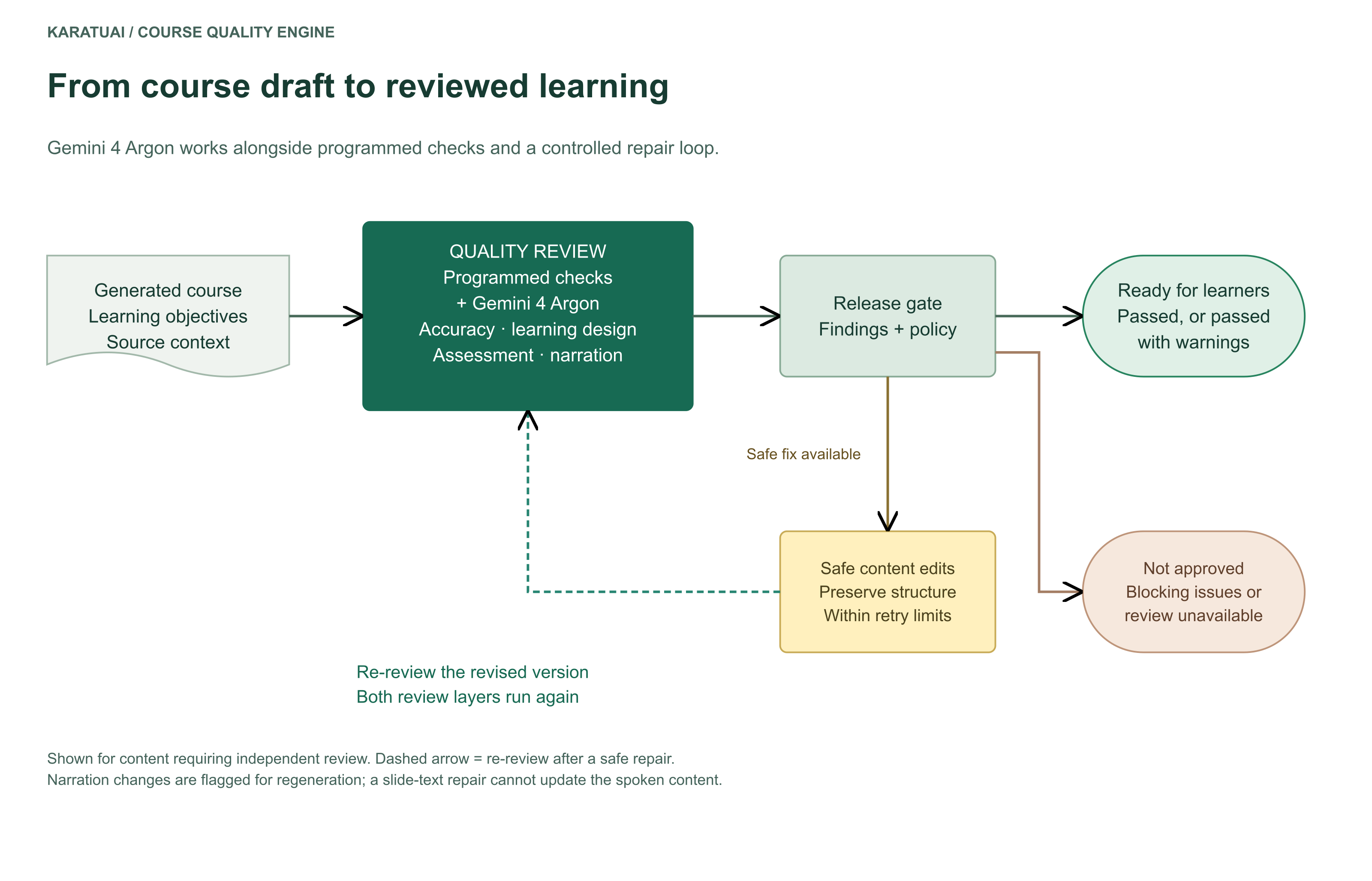
The review and repair flow. Safe corrections create a revised version for re-review; the quality policy determines whether content can be released.
Some problems need more than a small edit. For example, changing slide text cannot fix narration that repeats the original mistake. The reviewer can flag that narration for regeneration instead of treating a text correction as a complete repair.
Content that requires independent review must satisfy that requirement before approval. If the required review cannot complete, or blocking issues remain, it is not treated as ready simply because generation finished.
What this looks like in practice
In a small internal test using synthetic lesson segments, Argon identified a calculus quiz whose answer key contradicted the rule taught earlier in the lesson. It also noticed that the quiz repeated the exact problem already solved in the worked example—a useful prompt to consider whether the question should check application to a new example.
In another segment, it flagged a false causal claim and pointed out that the same claim appeared in the narration. Correcting only the slide would leave part of the learning experience inconsistent.
These examples show the kinds of relationships we ask Argon to examine: between an objective and an activity, an explanation and an answer key, or a slide and its narration.
Why we are building this into KaratuAI
For learners, the aim is a course that explains ideas coherently and gives them a fair opportunity to practise and show understanding. For teams building training, the same design priorities matter: content should stay connected to its intended learning outcomes, and assessments should check the skills people are expected to use.
Argon gives us another way to inspect a draft before it reaches that point. We are using its review capabilities to identify specific weaknesses, support constrained corrections and make unresolved issues visible in the release decision.
We will continue evaluating that process with representative content and educator feedback. The standard we are working toward is practical: courses whose explanations, activities and assessments support the learning they promise.
Evidence note: This article describes the implemented review workflow and illustrative findings, rather than a measured improvement in learning outcomes. The six-segment pilot used AI-assisted fixtures and adjudication, with independent educator review pending. The earlier reviewer identified all five planted errors; Argon identified four, with one case unverified after a timeout. The intended controls also contained a feedback-presentation weakness. These results do not establish an overall quality uplift, and no repairs were applied in that pilot.